GoMRI eNews · Jun 23, 2020 · ← All issues
Welcome to the GoMRI eNews.

Keeping you current on emerging Gulf science and the people investigating the effects of oil spills on the environment and public health.

June 23, 2020                                                                    GoMRI eNews

Stories

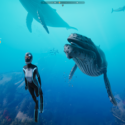
ECOGIG Research Informs Development of Ocean-Based Video Game: Beyond Blue

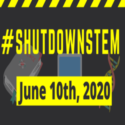
On Wednesday, June 10th, GoMRI leadership stood in solidarity with #ShutDownSTEM. GoMRI fully acknowledges that Black Lives Matter and changes need to be made in the scientific community, and we will work with our communities to eliminate racism from scientific research. We stand behind the recent statements made by AAAS and our partner organizations.

Sea Grant Releases Report on Fostering Researcher-Responder Collaboration

From the Archives

Study Describes Six-Year Evolution of Gulf Sediments Following Deepwater Horizon

Posted on June 18, 2019
Scientists adapted high-resolution sampling and analyses methods to assess Gulf of Mexico sediment core samples collected from 2010-2016 and identify sedimentation changes that followed Deepwater Horizon.

Study Finds Currents One Centimeter Below Ocean’s Surface Greatly Affect Material Transport

Posted on June 14, 2018
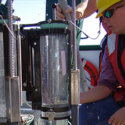
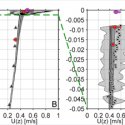
Researchers conducted a first-of-its-kind measurement of the vertical dynamics of water motion near the ocean’s surface in the northern Gulf of Mexico.

Grad Student Mahmud Makes Acoustics and Tracking Marine Mammals “Click”

Posted on June 22, 2017
Sakib Mahmud tests combinations of passive acoustic monitoring equipment to find the best method to detect and measure marine mammal populations affected by the Deepwater Horizon oil spill. His findings will help improve our understanding of long-term environmental impacts of the spill on deep-diving marine mammals and aid in improving oil spill regulations, monitoring, and mitigation efforts.
Study Observes Mobile Bay Plume Dynamics on Coastal Circulation

Posted on June 14, 2016
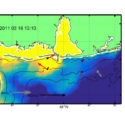
Scientists monitored a major river discharge event in Mobile Bay in March 2011 to better understand how such inputs affect Gulf of Mexico nearshore water transport.

Publications

Study Determines Rate and Extent of Hydrocarbon Removal in 15-Day Mesocosm System
A mesocosm experiment to determine half-lives of individual hydrocarbons in simulated oil spill scenarios with and without the dispersant, Corexit. Shi, D.; Bera, G.; Knap, A.H.; Quigg, A.; Al Atwah, I.; Gold-Bouchot, G.; Wade, T.L. Marine Pollution Bulletin Volume 151, February 2020, 110804

Mesocosm Study Monitors Oil Composition Changes in Open-Ocean and Coastal Waters  
Mesocosm experiments to better understand hydrocarbon half-lives for oil and oil dispersant mixtures. Morales-McDevitt, M.E.; Shi, D.; Knap, A.H.; Quigg, A.; Sweet, S.T.; Sericano, J.L.; Wade, T.L.; Corsi, I. PLoS ONE 15(1): e0228554.

Data

Stable isotopic composition of carbon and nitrogen in coral tissue collected aboard multiple cruises around areas of natural seepage in the Gulf of Mexico from 2015-04-29 to 2017-08-04 -- data link

Laboratory photo-microcosms - Emulsion molecular-level data -- data link

Multiple hydrocarbon data from mangrove forests collected during a coastal survey conducted in the Bay of Campeche, southern Gulf of Mexico from 2016-08-09 to 2016-08-10 -- data link

Announcements

Sea Grant Webinars on Oysters Begins June 26 
The Sea Grant Oil Spill Outreach Team is hosting three webinars on oysters. The first one titled "Oysters: Adapting to a Changing Gulf, A Three-Part Series" is on June 26 10:30 AM Central Time and will discuss the role of oysters in our estuarine ecosystem and the threats facing them. Read more here:https://gulfseagrant.org/oilspilloutreach/presentations/oysters-adapting-to-a-changing-gulf/. Register here:https://usmuw.co1.qualtrics.com/jfe/form/SV_6m3OCf0LqeQ6Jsp. More information will be available soon on the July Webinar (TBD) "Increasing Resilience of Wild and Farmed Oysters Before, During, and After an Oil Spill" and the August Webinar (TBD) "How Oil spill Response Decisions Affect Oysters." 

Sea Grant Webinars on Human Health Impacts from Oil Spills
The Sea Grang Oil Spill Outreach Team is hosting three webinars on "Detecting the True, Potential, and Perceived Impacts to Human Health Following an Oil Spill, a Three-Part Series." The first webinar titled "Impacts of Oil Spills on Air Quality" was held on June 8, and presentation videos are available at https://gulfseagrant.org/oilspilloutreach/presentations/webinar-series-detecting-the-true-potential-and-perceived-impacts-to-human-health-following-an-oil-spill/. More information will be available soon on the two remaining webinars (July TBD) titled "Impacts of Oil Spills on Water Quality" and "Impacts of Dispersants on Human Health." 

Sea Grant Webinar on Oil In the Environment
Coming in July (TBD) is the webinar titled "Breaking it Down: Oil in the Environment. More information is available at https://gulfseagrant.org/oilspilloutreach/presentations/breaking-it-down-oil-in-the-environment/.

Sea Grant Webinar on Marine Snow
Coming in July (TBD) is the webinar titled "Every Snow Often Oil, Microbes, and Sediment Get Together and Sink. More information will be available soon at https://gulfseagrant.org/oilspilloutreach/presentations/.