GoMRI eNews · May 12, 2020 · ← All issues
Welcome to the GoMRI eNews.

Keeping you current on emerging Gulf science and the people investigating the effects of oil spills on the environment and public health.

May 12, 2020                                                                    GoMRI eNews

Stories

New Report! Deepwater Horizon Discoveries of How Microbes Mitigate Oil Spills

A Decade of Research Reveals Significance of Sunlight’s Effects on Floating Oil

Sociologists Link Lessons from Deepwater Horizon to Long-Term Coronavirus Impacts

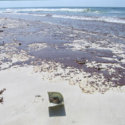
Oil Spill Research Consortium Publishes Summary Highlights of Their Findings

From the Archives

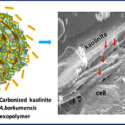
Study Demonstrates How Natural Clay Particles Enhance Oil Dispersion and Biodegradation

Posted on May 7, 2019
Scientists conducted laboratory experiments using an abundant natural clay material, kaolinite, modified with carbon derived from chitosan as an environmentally friendly alternative to chemical dispersants and visualized resulting phenomena at nanoscale detail.

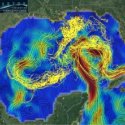
Study Finds Small Scale Ocean Currents Cause Clustering of Floating Material

Posted on May 10, 2018
Researchers analyzed how satellite-tracked ocean surface drifters moved in the Gulf of Mexico to learn how other floating materials (oil, plastics, marine organisms) move.

Studies Highlight Complexities in Connecting Larval Fish Health to Deepwater Horizon

Posted on May 9, 2017
Scientists examined Red Snapper and Spanish Mackerel larvae before, during, and after the Deepwater Horizon oil spill to determine if and how the spill may have affected them.

Publications

Study Highlights New or Adapted Technology Used in Oil Spill Research 
Technological advances in ocean sciences resulting from the Deepwater Horizon oil spill. Bracken, L.; DiNicola, D.; Kastler, J.; Beresford, S. Current: The Journal of Marine Education, 33(1), 33–41

Study Describes Improved Instrument to Analyze High Molecular Weight Hydrocarbons
Instrumental improvements for the trace analysis of structural isomers of polycyclic aromatic hydrocarbons with molecular mass 302 Da. Santana, A.; Comas, A.; Wise, S.; Wilson, W.B.; and, Campiglia, A.D. Analytica Chimica Acta Volume 1100, 1 March 2020, Pages 163-173

Data

Calculating sperm whale lengths from passive acoustic data using Matlab -- data link

Hydrophobic droplets trigger secretion of protein-rich microbial extracellular polymeric substances from phytoplankton -- data link

Acute toxicity of chemically enhanced water accommodated fraction (CEWAF) to deep-sea crustaceans and peppermint shrimp (Lysmata wurdemanni) -- data link

Announcements

Call for Papers: Predicting Hydrocarbon Fate in the Ocean
Editors invite papers that explore the fate of hydrocarbons in the ocean using multi-component numerical models, especially studies that explore the relationship between two or more processes, including microbial ecology, sediment transport, oil/gas plumes, and physical mixing and transport processes. They also welcome papers on related experimental aspects of these topics, i.e. that can contribute to modeling parameterization, calibration, and verification. Read more here. 

News Media Articles on 10th Deepwater Horizon Anniversary 
Check out GoMRI in the News to read recent media coverage featuring members of the GoMRI community and what has been learned since the oil spill.   

Project Activities

Blog: CARMMHA PI Discusses Long-Term Deepwater Horizon Impacts to Whales and Dolphins
In a recent blog post, consortium principal investigator Dr. Lori Schwacke explains the importance of documenting the long-term effects of spills like Deepwater Horizon on marine mammal populations and what her team has uncovered. Read the full entry here.
 
C-IMAGE Completes 16-Episode The Loop Podcast
The Loop, hosted by David Levin and in partnership with Mind Open Media, features consortium researchers as they share an in-depth look at how their science helps us understand oil spills. All 16 episodes are available for free on the C-IMAGE website, Apple Podcasts, and SoundCloud.