GoMRI eNews · Oct 29, 2019 · ← All issues
Welcome to the GoMRI eNews.

Keeping you current on emerging Gulf science and the people investigating the effects of oil spills on the environment and public health.

October 29, 2019                                                                    GoMRI eNews

Stories

Grad Student Montas Assesses Oil Spill Health Risks to Children During Beach Play

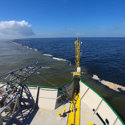
Study Provides Insights into How Floating Material Moves on the Ocean

Marine Mammal Research Team Receives Rollie Lamberson Modelling Award

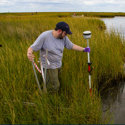
Grad Student Rayle Examines Changing Meiofauna Biodiversity in Oiled Marshes Using Bioinformatics

From the Archives

Study Is First to Examine How Oil and Gas Tumbling Inside Pipe Affects Released Oil Estimations

Posted on October 17, 2018
Scientists analyzed visual observations and computer simulations of the Deepwater Horizon oil flow to better understand the characteristics of an uncontrolled pipeline flow and how they affect the amount of oil discharge and droplet size distribution, which are critical for effective response decisions.

Study Finds Low Oil Concentrations Impair Self-Preservation Behaviors in Coral Reef Fish Larvae

Posted on October 26, 2017
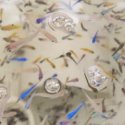
Researchers from the United States, Australia, and Europe conducted mesocosm experiments to assess how larval reef fishes respond physiologically and cognitively to low crude oil concentrations. The team observed that polycyclic aromatic hydrocarbons (PAHs), at levels recorded in industrialized sections of tropical coral reefs worldwide, increased larvae mortality and stunted growth rates.

Grad Student Fiore Investigates Oil Spill Impacts on Gulf Economy and Fisheries Resiliency

Posted on October 25, 2016
Natural and manmade disasters often involve long-term effects, but the majority of follow-up research tends to focus on the biophysical impacts rather than the social. Jacqueline Fiore, a Louisiana resident, understands how disasters such as hurricanes and oil spills can impact local industries, citizens, and ecosystems.

Publications

Study Assesses Genomic Effects of Oil and Dispersants on Mahi Embryos
Effects of corexit 9500A and Corexit-crude oil mixtures on transcriptomic pathways and developmental toxicity in early life stage mahi-mahi (Coryphaena hippurus).Greer, J.B.; Pasparakis, C.; Stieglitz, J.D.; Benetti, D.; Grosell, M.; Schlenk, D. Aquatic Toxicology, Volume 212, July 2019, Pages 233-240

Study Summarizes Research on Oil Impacts Across Ray-Fin Fish Species
Impacts of Deepwater Horizon oil on fish. Pasparakis, C.; Esbaugh, A.J.; Burggren, W.; Grosell, M. Comparative Biochemistry and Physiology Part C: Toxicology & Pharmacology, Volume 224, October 2019, 108558

Data

Size-fractionated gut fluorescence from mesozooplankton collected aboard R/V Point Sur cruise BCS01 in the northern Gulf of Mexico from 2016-02-10 to 2016-02-12 -- data link

Microbial community composition of sediments associated with co-occurring Avicennia sp. and Spartina sp. in Chandeleur Island salt marsh seven and eight years post-Deepwater Horizon from 2017-05-30 to 2018-06-13 -- data link

Toxicity of toluene to Solenastrea bournoni -- data link

Announcements

Latest News for 2020 Gulf of Mexico Oil Spill & Ecosystem Science Conference (GoMOSES)
  • Hotel Reservations There are reserved room blocks at the Tampa Marriott Water Street Hotel (the conference venue) and the Barrymore Hotel. Attendees who stay at either hotel will receive discounted registration. When registering for the conference, please be prepared to enter your hotel confirmation number to receive the discount. Book Marriott hotel here. Book Barrymore hotel here.
  • Early Registration Ends November 27  The full conference registration fee covers entry to all conference activities, including workshops, breaks, and breakfast. When registering for the conference, please enter your hotel confirmation number to receive the discount (Marriott Water Street hotel and Barrymore hotel only). 
- Early Bird (on or before November 27, 2019) $550 ($450 with conference hotel reservation).
- Regular (after November 27) $650. ($550 with conference hotel reservation).
- Student - $300 ($250 with conference hotel reservation).
- One-day Early (on or before November 27) $250 (no hotel reservation required).
- One-day Regular (after November 27) $300 (no hotel reservation required).
- Workshop-Only $250 (attendance only at a workshop and not any part of the conference).
- Onsite registration will be available subject to a $50 late fee

Project Activities

C-IMAGE Researchers to Feature in PBS’s Changing Seas
PBS recently interviewed Drs. Steve Murawski and David Hollander for an upcoming episode exploring what has happened in the ten years since the Deepwater Horizon oil spill. Changing Seas gives viewers a firsthand look at how researchers study the ocean and how human activities threaten ocean resources. Learn more about Changing Seas here.
 
ECOGIG Scientists Participate in Smithsonian “Expert Is In” Event
Drs. Samantha Joye and Erik Cordes hosted a “Creatures of the Deep” table at the GoMRI-sponsored event that taught museum visitors about the Gulf of Mexico’s beautiful yet mysterious deep-sea corals and the team’s research into Gulf methane seeps.