|
|
|
|
September 17, 2019 GoMRI eNews
|
|
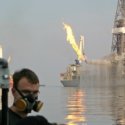
Predicting where oil will go can be one of the most challenging aspects of marine oil spill response.
|
|
|
Scientists isolated bacteria from Gulf of Mexico surface waters and used them in microcosm experiments to identify those that simultaneously degrade oil and produce mucus-like materials (exopolymeric substances or EPS).
|
|
|
Meiofauna are microscopic marine organisms that live between grains of sand in ocean, coastal, river, and stream sediments and provide important services such as recycling organic material in the sediment that contribute to healthy marine ecosystems.
|
|
|
The leaders of the GoMRI Core Area 6 synthesis effort are pleased to announce Session 22, entitled Microbial Genomics to Improve Predictive Understanding of Disturbance in the Global Ocean System, at the 2020 Gulf of Mexico Oil Spill and Ecosystem Science Conference.
|
|
|
Posted on September 6, 2018
Petroleum hydrocarbons released by oil spills can accumulate on beaches and in nearshore sediments, potentially creating health risks for humans and coastal organisms. However, the highly variable conditions of beach environments make it difficult to determine the long-term behavior and fate of hydrocarbons in sands and sediment.
|
|
|
Posted on September 14, 2017
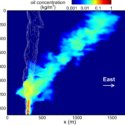
Scientists used data collected during the Deepwater Horizon spill to validate a model simulation of the physical and chemical behavior of oil and gas rising from the wellhead to the ocean surface.
|
|
|
Posted on September 6, 2016
Deep ocean oil plumes that formed from the Deepwater Horizon spill and their subsequent rise through the water column were greatly influenced by physical mixing mechanisms such as turbulence, Langmuir circulations, and sub-mesoscale eddies.
|
|
|
Study Presents First High-Resolution Characterization of a Hydrocarbon Seep at GC600
High-resolution seismo-acoustic characterization of Green Canyon 600, a perennial hydrocarbon seep in Gulf of Mexico deep water. Diercks, A.-R.; Macelloni, L.; D Emidio, M.; Lucker, S.; Woolsey, A.; Woolsey, M.U. Marine Geophysical Research (2018), pp 1-14, https://doi.org/10.1007/s11001-018-9374-3
Study Gives Insight Into How Oceanic Trapping Features Affect Drifter Statistics Analysis
Impacts of convergence on structure functions from surface drifters in the Gulf of Mexico. Pearson, J.; Fox-Kemper, B.; Barkan, R.; Choi, J.; Bracco, A.; McWilliams, J.C. Journal of Physical Oceanography, 2019, 49, 675–690, https://doi.org/10.1175/JPO-D-18-0029.1
|
|
Oil Composition and nutrients for the GOMCOAST mesocosm using Gulf Of Mexico COASTal water -- data link
Phyto-PAM-Fluorescence data: Effect of water-accommodated fraction (WAF) and water-soluble fraction (WSF) on phytoplankton’s photosynthetic performance and their relative abundance -- data link
Metatranscriptomes: Gulf of Mexico Open Ocean (GOMOO) and Gulf of Mexico Coastal Waters (GOMCOAST) -- data link
|
|
Sept 30 Deadline: Submit Abstracts for the 2020 GoMOSES Conference
The 2020 Gulf of Mexico Oil Spill and Ecosystem Conference is soliciting abstracts that share the latest research findings and support interdisciplinary dialogue about research implications, applications, and synthesis. Priority will be given to abstracts that promote fundamental Gulf of Mexico ecosystem science and link scientific results to ecosystem resilience, oil spill response, or restoration and management. Abstract submission ends September 30, 2019. Click here to submit an abstract. You do not need to be registered to submit an abstract.
Registration Open for 2020 GoMOSES Conference
Register now for the 2020 Gulf of Mexico Oil Spill and Ecosystem Science Conference. The full conference registration fee covers entry to all conference activities, including workshops, breaks, and breakfast. Attendees who stay at the Tampa Marriott Water Street (the conference venue) will receive a discount on registration. When registering for the conference, please enter your hotel confirmation number to receive the discount. Click here to make a reservation at the Marriott.
- Early Bird (on or before November 30, 2019) - $550 ($450 with conference hotel reservation).
- Regular (after November 30) - $650. ($550 with conference hotel reservation).
- Student - $300. ($250 with conference hotel reservation).
- One-day Early (on or before November 30) - $250 (no hotel reservation required).
- One-day Regular (after November 30) - $300 (no hotel reservation required).
- Workshop-Only - $250 (attendance only at a workshop and not any part of the conference).
- Onsite registration will be available subject to a $50 late fee.
Sea Grant Publication Looks at Technology and Oil Spills
When an oil slick spreads on the surface of the water, scientists have an array of special equipment to track it. The science outreach team’s latest publication In the air and on the water: Technology used to investigate oil spills outlines various technologies available at and above the water’s surface—all the way up to satellites in space—to study oil in the marine environment.
IOSC 2020 Scholarship Applications Now Being Accepted
The International Oil Spill Conference (IOSC), May 11-14 in New Orleans, LA, is offering need-based scholarships to help with registration and travel expenses for those whose attendance would enhance the body of knowledge for the oil spill science user community. Submit your scholarship application by November 15 to be considered. IOSC provides a vital forum for the oil industry to gather and discuss how to handle the greatest challenges and opportunities on the horizon with sound science, practical innovation, global research, and imagination. The IOSC 2020 Scholarship Committee reviews and approves applications.
|
|
ECOGIG Participates in 10th Annual Athens Water Festival
Consortium researchers welcomed festival visitors to the Ocean Discovery Zone, where they could learn about deep-sea corals, drive a model remotely operated vehicle (ROV), and create a deep-sea tube worm puppet.
RECOVER Tuesday Tool Profile Highlights Cryosection
Dr. Yadong Wang at the University of Miami's Rosenstiel School of Marine & Atmospheric Science uses cryosection to rapidly freeze mahi-mahi larvae (approximately -30°C) and slice them as thinly as up to 1 micrometer. She combines this technique with immunohistology to determine where specific genes are expressed in early life stage mahi-mahi and how they are affected by oil exposure.
|
|
|
|
|
|
|