|
|
|
|
March 19, 2019 GoMRI eNews
|
|
The Gulf of Mexico Research Initiative is pleased to announce a new Sea Grant product that gives a concise overview of the Stafford Act (1988) and the Oil Pollution Act (1990) that govern oil spill response.
|
|
|
Scientists used next-generation sequencing to analyze deep-sea corals following the Deepwater Horizon incident.
|
|
|
The Gulf of Mexico Research Initiative (GoMRI) congratulates Dr. Joseph Katz on his election to the National Academy of Engineering 2019 class, one of the highest professional distinctions accorded to an engineer.
|
|
|
Posted on March 13, 2018
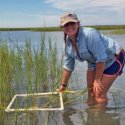
Major disturbances such as oil spills can significantly affect populations of vulnerable saltmarsh species, which may result in greater impacts to the overall saltmarsh food web. Shelby Ziegler believes that a better understanding of what saltmarsh predator-prey interactions look like today can help identify changes in the food web following disturbances in the future.
|
|
|
Posted on March 14, 2017
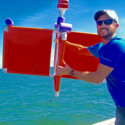
When Deepwater Horizon oil approached coastal environments, it was unclear how river water entering the Gulf of Mexico would affect the oil’s transport and fate. Steve Dykstra uses drifters and ship-deployed sensors to study how freshwater plumes disperse in the coastal environment over different seafloor topography.
|
|
|
Posted on March 7, 2016
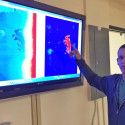
Juan Pinales is working on a computational modelling system that will aid oil spill monitoring efforts. He combines Synthetic Aperture Radar (SAR) data and oceanographic conditions recorded during the Deepwater Horizon incident to improve surface oil detection using a semi-automated machine learning method known as artificial neural networking.
|
|
|
Study Gives 2-Page ShapShot of Complex Microbial Biodegradation Dynamics
SnapShot: Microbial Hydrocarbon Bioremediation. Joye, S.; Kleindienst, S.; Pena-Montenegro, T.D. Cell, Volume 172, Issue 6, 8 March 2018, Pages 1336-1336.e1
Study Shows Clay Minerals as Sustainable and Green Alternative to Chemical Dispersants
Engineered Clays as Sustainable Oil Dispersants in the Presence of Model Hydrocarbon Degrading Bacteria: The Role of Bacterial Sequestration and Biofilm Formation. Omarova, M.; Swientoniewski, L.T.; Tsengam, I.K.M.; Panchal, A.; Yu, T.; Blake, D.A.; Lvov, Y.M.; Zhang, D.; John, V. ACS Sustainable Chemistry & Engineering, 2018, 6, 11, 14143-14153
|
|
Sediment core photographs collected aboard R/V Weatherbird II cruises WB-0717 and WB-1217 in the Gulf of Mexico from 2017-07-19 to 2017-12-05 -- data link
Sediment texture and composition data collected aboard R/V Weatherbird II cruise WB-0717 in the Gulf of Mexico from 2017-07-22 to 2017-07-28 -- data link
Marine gels, extracellular polymeric substances (EPS) and transparent exopolymeric particles (TEP) in natural seawater and seawater contaminated with a water accommodated fraction of Macondo oil surrogate -- data link
|
|
May 15 Deadline for IOSC 2020 Abstract Submission
The International Oil Spill Conference (IOSC) is seeking thematically related papers and posters for its next convening in New Orleans, Louisiana, on May 11 – 14, 2020. Submit abstracts here.
March 29 and April 5: Regional Priority-Setting for Health, Social, and Economic Disruption from Spills Workshops.This public health series is hosted by the National Academies, GoMRI, and Sea Grant. The meeting in Virginia Beach, Virginia will be on March 29 and in Santa Barbara, California on April 5. Learn more here.
|
|
|
|
|
|
|