|
|
|
|
June 26, 2018 GoMRI eNews
|
|
Researchers identified small- to hurricane-scale resuspension events using time-series data of sinking organic material near the Deepwater Horizon site.
|
|
|
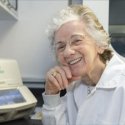
The Gulf of Mexico Research Initiative congratulates Dr. Rita Colwell on her selection as the 2018 Lee Kuan Yew Water Prize Laureate for her work in revolutionizing the fight against water borne diseases.
|
|
|
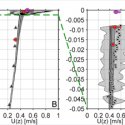
Researchers conducted a first-of-its-kind measurement of the vertical dynamics of water motion near the ocean’s surface in the northern Gulf of Mexico.
|
|
|
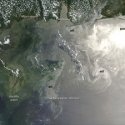
The Smithsonian’s Ocean Portal published an interactive tool featuring maps and graphics showing where Deepwater Horizon oil traveled. The story map also includes locations for where responders applied chemical dispersants on the Gulf’s surface and other sources where oil enters the Gulf, such as offshore oil and gas platforms and natural seeps.
|
|
|
Posted on June 22, 2017
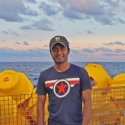
Sakib Mahmud tests combinations of passive acoustic monitoring equipment to find the best method to detect and measure marine mammal populations affected by the Deepwater Horizon oil spill. His findings will help improve our understanding of long-term environmental impacts of the spill on deep-diving marine mammals and aid in improving oil spill regulations, monitoring, and mitigation efforts.
|
|
|
Posted on June 28, 2016
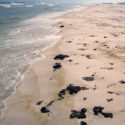
Spilled oil buried in nearshore sediment can persist for many years and act as a long-term source of episodic hydrocarbon contamination in the environment.
|
|
|
Posted on June 18, 2015
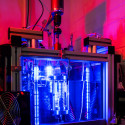
Scientists at the University of Miami and the University of Western Australia measured oil droplet size and simulated oil dispersion under conditions similar to those at the Deepwater Horizon wellhead.
|
|
|
Study Assesses Visual Impacts and Gene Expression Changes from Oil and Dispersant on Deep-Sea Coral
Stress response of the black coral Leiopathes glaberrima when exposed to sub-lethal amounts of crude oil and dispersant. Ruiz-Ramos, D.V.; Fisher, C.R.; Baums, I.B. Elementa Science of the Anthropocene, 201, 5:77
Study Finds Marine Snow Inhibits Oil Biodegradation in Sediment
Marine snow increases the adverse effects of oil on benthic invertebrates. van Eenennaam, J.S.; Rahsepar, S.; Radovic, J.R.; Oldenburg, T.B.P.; Wonink, J.; Langenhoff, A.A.M.; Murk, A.J.; Foekema, E.M. Marine Pollution Bulletin, Volume 126, January 2018, Pages 339-348
|
|
ADCP Data from a Floating Sediment Trap, Gulf of Mexico, June 4 to 19, 2017 -- data link
Comparison of oil slick and drifter motion at OHMSETT wave tank -- data link
Mixing Array Bottom Moorings for Mobile Bay, March 29 to April 15, 2016 -- data link
|
|
Now Available! The Spring 2018 GoMRI Quarterly Newsletter
Features include the GoMRI Synthesis & Legacy effort, data FAQ's with Dr. Peter Brewer, an interview with Dr. Andres Campiglia, and much more!
July 1 Deadline: Call for Sessions 2019 Gulf of Mexico Oil Spill and Ecosystem Science Conference
Strong consideration will be given to proposals which offer some combination of physical/geochemical processes; social, health, and biological impacts; communications and outreach; and response, restoration, or management implications. Submit session abstracts here. Click here for guidance and instructions.
July 2 Deadline: Request for Sample Analysis Funds
The GoMRI Research Board announces the availability of up to $2 million in additional funding for Request for Sample Analysis Funds. This funding will support sample analysis expenditures, including costs for sample processing, analysis, and interpretation of results. For more information, click here.
GoMRI Synthesis & Legacy Webpage is Live!
The Synthesis and Legacy webpage is available at http://gulfresearchinitiative.org/gomri-synthesis/. Frequency Asked Questions are available at http://gulfresearchinitiative.org/synthesis-legacy-frequently-asked-questions/.
The Science Decoders: Sea Grant Oil Spill Outreach Team Featured in Ecomagazine
This article describes the team's activities including publications, seminars, and bridging the gap between emergency responders, researchers, public health officials, the tourism industry, and fishers.
|
|
ADDOMEx Features Undergraduate Student Yard
Alexandra Yard is a sophomore at Texas A&M University at Galveston working with the ADDOMEx-2 project in Dr. Peter Santschi’s oceanography and environmental research lab. You can read her insights on the effects of exopolymeric substances and surfactant on surface tension here.
Get to Know CARMMHA Researcher Randy Wells
Wells has spent over 45 years researching bottlenose dolphin health. His long-term monitoring of a Sarasota Bay dolphin population can provide reference information and establish baselines that can be used to determine the health and population dynamics of populations at-risk after major events such as oil spills.
ECOGIG Hosts 3rd Annual Ocean Discovery Camp
Partnered with the University of Georgia’s Summer Academy, the camp used hands-on projects, crafts, games, videos, and photo slideshows to explore deep oceans and the pollution, oil spills, and climate change that threaten it. Campers also designed, built, and test drove their own remotely operated vehicle models.
RECOVER Researchers Demonstrate How to Create HEWAF Samples
HEWAFs (high energy water accommodated fractions) are created by thoroughly mixing source oil and seawater. The team is practicing creating these samples in preparation for the upcoming MAHI2018 research cruise.
|
|
|
|
|
|
|