|
|
|
|
June 12, 2018 GoMRI eNews
|
|
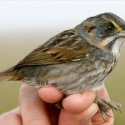
Researchers analyzed the resource use of Seaside Sparrows residing in salt marshes impacted by large-scale disturbances like Deepwater Horizon and Hurricane Isaac to understand the effects on these indicators of ecological change.
|
|
|
The Gulf of Mexico Research Initiative (GoMRI) is pleased to announce a new Sea Grant publication that provides helpful tips for what to do if you come upon an oiled animal in the wild, including phone numbers for state-level animal-specific rescue authorities.
|
|
|
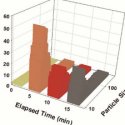
Researchers conducted laboratory wave tank experiments to investigate how plunging breaking waves affect the concentration of particulate and gaseous emissions from oil slicks.
|
|
|
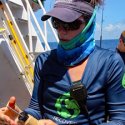
Laboratory studies at the University of Miami suggest that exposure to Deepwater Horizon oil may have negatively affected heart function in mahi-mahi, reducing their ability to swim efficiently. Lela Schlenker is expanding that research to investigate if and how oil exposure alters the way mahi-mahi migrate and respond to predators and prey in the wild.
|
|
|
Posted on June 6, 2017
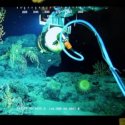
A 12-day science expedition on the exploration vessel Ocean Intervention II embarks June 11 to investigate how oil, gas, and chemical dispersants affect marine life and their environment deep in the Gulf of Mexico. Scientists and outreach personnel onboard the vessel will interact with the public and school-age children using streaming video, social media, and question-and-answer sessions.
|
|
|
Posted on May 31, 2016
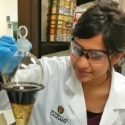
As a child in India, Aprami Jaggi witnessed firsthand how polluted water sources impact society. Her desire to make water remediation her life’s work has led her from Delhi to Calgary, Canada, to study oil mitigation.
|
|
|
Posted on June 9, 2015
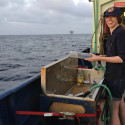
Scientists from Haverford College examined Gulf of Mexico sediment and flocculent material (floc) associated with oil-impacted corals to study indigenous microbial communities and their oil degradation potential.
|
|
|
Study uses MIMOSA System to Quantify Microbial Responses to Oil in Deep-Sea Sediment
Microbial response to oil enrichment in Gulf of Mexico sediment measured using a novel long-term benthic lander system. Orcutt, B.N.; Lapham, L.L.; Delaney, J.; Sarode, N.; Marshall, K.S.; Whaley-Martin, K.J.; Slater, G.; Wheat, C.G.; Girguis, P.R. Elementa Science of the Anthropocene: 2017; 5: 18.
Study Uses Economical 2D Model to Compute Multiphase Oil Plume Behavior
Rotating 2d point source plume models with application to Deepwater Horizon. Fabregat, A.; Deremble, B.; Wienders, N.; Stroman, A.; Poje, A.; Ozgokmen, T.M.; Dewar, W.K. Ocean Modelling, Volume 119, November 2017, Pages 118-135
|
|
Raw acoustic scattering data of organisms from the water column, cruise DP05, April 2017 – May 2017 -- data link
Unified Wave INterface - Coupled Model (UWIN-CM) output of Hurricane Ike (2008) and Superstorm Sandy (2012) -- data link
Reson Seabat 7125 multibeam sonar bathymetry and backscatter from Mississippi Bight, cruise PTS03, July 23-31, 2016 -- data link
|
|
GoMRI Synthesis & Legacy Webpage Live!
The webpage provides the context for how the synthesis and Legacy effort evolved, 5 key questions that will be addressed, objectives and mission, and the 8 core synthesis areas. There is an FAQ page that will be updated regularly.
Funding Opportunity: Request for Sample Analysis Funds
The GoMRI Research Board is pleased to announce the availability of up to $2 million in additional funding for Request for Sample Analysis Funds. This funding will support sample analysis expenditures, including costs for sample processing, analysis, and interpretation of results. For more information, click here.
Call for Sessions: 2019 Gulf of Mexico Oil Spill and Ecosystem Science Conference
The conference committee is soliciting session proposals to address the conference theme "Minding the Gaps: Research Priorities for Response, Restoration, and Resilience." Strong consideration will be given to proposals that offer some combination of physical/geochemical processes; social, health, and biological impacts; and response, restoration, or management implications. The deadline to submit a proposal is July 1, 2018(11:59 pm Pacific Time). Submit session abstracts here. Click here for guidance and instructions.
|
|
|
|
|
|
|