|
|
|
|
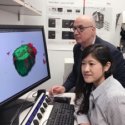
“I was not going to be stopped,” said Dr. Rita Colwell describing how she faced hurdles, many related to being a woman during her 60+ year science career, and blazed paths, including her being the first female director of the National Science Foundation. She spoke earnestly and enthusiastically to faculty, staff, and students gathered for the two-day Career and Leadership event at the University of Miami (UM) Rosenstiel School for Marine and Atmospheric Science (RSMAS).
|
|
|
Researchers analyzed 3D renderings of oil-particle aggregates to better understand their interactions in turbulent environments. The team found that hydrodynamic forces can cause sediment particles to act as projectiles that penetrate oil droplets.
|
|
|
The United Nations is developing the 2nd World Ocean Assessment and is looking for scientists from a broad range of marine-related disciplines to join their Pool of Experts. Scientists with expertise in the world’s ocean and marine areas, and especially those with experience in social sciences, are encouraged to apply.
|
|
|
Posted on April 26, 2017
The Sea Grant Oil Spill Outreach Program is collaborating with NOAA entities to extend the two-way dialogue with sectors who were impacted by the Deepwater Horizon oil spill.
|
|
|
Posted on April 20, 2016
Communicating oil spill research is essential to improve society’s understanding about spills and their ability to respond to and mitigate them. The Gulf of Mexico Research Initiative (GoMRI) has been funding spill-related research since 2010.
|
|
|
Posted on April 27, 2015
The prevention or reduction of coastline oiling was high on responders’ priorities immediately following the 2010 Deepwater Horizon oil spill. Five years later, much discussion continues about balancing benefits and risks regarding dispersants, and there are increased research efforts for alternatives or enhancements to existing dispersant systems.
|
|
|
Study Finds Oil Exposure Affects Fiddler Crabs' Digestive Gland and Burrowing Behavior
Crude oil toxicity to fiddler crabs (Uca longisignalis and Uca panacea) from the northern Gulf of Mexico: Impacts on bioturbation, oxidative stress, and histology of the hepatopancreas. Franco, M.E.; Felgenhauer, B.E.; Klerks, P.L. Environmental Toxicology and Chemistry, Volume37, Issue2, February 2018, Pages 491-500
Study Finds that Near-Surface Shear Rapidly Separates Pieces of Marine Debris
Observations of Near-Surface Current Shear Help Describe Oceanic Oil and Plastic Transport. Laxague, N.J.M.; Ozgokmen, T.M.; Haus, B.K.; Novelli, G.; Shcherbina, A.; Sutherland, P.; Guigand, C.M.; Lund, B.; Mehta, S.; Alday, M.; Molemaker, J. Geophysical Research Papers, Volume45, Issue1, 16 January 2018, Pages 245-249
|
|
Dataset for: Impact of particle concentration and out-of-range sizes on the measurements of the LISST -- data link
Dataset for: Vertical and horizontal resolution dependency in the model representation of tracer dispersion along the continental slope in the northern Gulf of Mexico -- data link
Large eddy simulation of the mixed layer, wind and cooling only -- data link
|
|
|
|
|
|
|