|
|
|
|
February 7, 2017 GoMRI eNews
|
|
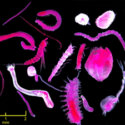
Meiofauna are invertebrate organisms that live in seafloor sediments. These marine creatures perform ecosystem functions such as trophic transfer, biogeochemical cycles, pollution removal, and sediment transport stability.
|
|
|
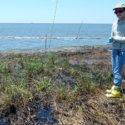
Scientists analyzed weathered and fresh Macondo oil to learn about oil products resulting from microbial degradation and photochemical reactions. They observed that 48 months after the Deepwater Horizon spill, less than 1 percent of oil remained in marsh sediments collected from heavily-impacted sites; however, it was still 400 times greater than sites with moderate-to-no observed oiling.
|
|
|
Oil droplets can attach to tiny sediment particles suspended in the water column, causing them to sink to the seafloor where they can linger for a long time. Sediment grain size influences if and how oil droplets are resuspended into the water column.
|
|
|
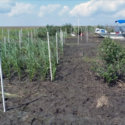
Marshes depend on a healthy, well-functioning complex of plants, microbes, and benthic communities to support the environmentally and economically important ecosystem services they offer, such as reducing storm surges and providing nursery grounds for many species.
|
|
|
Posted on January 26, 2016
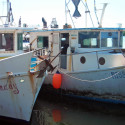
Authorities closed large portions of the Gulf of Mexico to commercial and recreational fishing following the Deepwater Horizon oil spill to contain and mitigate oil contamination of fish and seafood products. The fishing closures may have caused many fishers to search for alternative income solutions, such as relocating or chartering their vessels for the cleanup process.
|
|
|
Posted on January 22, 2015
To show how the Deepwater Horizon oil spill impacted the Gulf of Mexico, Sarah Tominack is going back to basics.
|
|
|
Posted on February 4, 2014
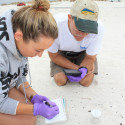
Talk about compounding interest! Put together scientists and teachers who are passionate about their work with students who are eager to help with ongoing research and watch as excitement fuels student engagement, sparks career interest, and feeds enthusiasm of all.
|
|
|
Modeling Study Shows Gas Bubbles Enhance Mixing Energy in Subsea Blowouts
Evolution of bubble size distribution from gas blowout in shallow water. Zhao, L.; Boufadel, M.C.; Lee, K.; King, T.; Loney, N.; Geng, X. Journal of Geophysical Research: Oceans, Volume 121, Issue 3, March 2016, Pages 1573–1599.
Study Characterizes Natural Deep Sea Seeps
Morpho-acoustic characterization of natural seepage features near the Macondo Wellhead (ECOGIG site OC26, Gulf of Mexico). Conti, A.; D'Emidio, M.; Macelloni, L.; Lutken, C.; Asper, V.; Woolsey, M.; Jarnagin, R.; Diercks, A.; Highsmith, R.C. Deep Sea Research Part II: Topical Studies in Oceanography, Volume 129, July 2016, Pages 53–65.
|
|
Dataset for: Microstructures of capped ethylene oxide oligomers in water and n-hexane -- data link
Cruise data for neuston net and paired bongo net tows from 48 stations in the northern Gulf of Mexico from R/V Blazing Seven cruises LF2016A and LF2016B, June-July 2016 -- data link
|
|
|
GoMRI RFP-V: Topography of Gulf of Mexico Influences Mixing and Distribution of Oil and Gas (Polzin)
Project is lead by P.I. Kurt Polzin, Woods Hole Oceanographic Institution.
|
|
|
GRIIDC Workshops at the 2017 Gulf of Mexico Oil Spill & Ecosystem Science Conference
GRIIDC will host the following 25 minute long workshops in Bolden 4
- Dataset Management Planning via the GRIIDC Dataset Information Form (DIF) Tuesday Feb 7, 3:30 PM
- Organizing Your Data – Best Practices and GRIIDC Submissions, Wednesday Feb 8, at 10:30 AM and Thursday Feb 9, at 8:15 AM
- Submitting your Data to GRIIDC, Wednesday Feb 8, at 3:30 PM and Thursday Feb 9, at 10:30 AM
GRIIDC Announces 1,000 Datasets Available for Download
This important milestone was reached in October 2016, and the number of datasets publicly available continues to increase daily.
Application Open for Training in Open Science and Synthesis through the Gulf Research Program.
Members from NCEAS, DataONE and Data Carpentry are teaming together to provide an NCEAS led, 3-week open science training event. This training event will be hosted by the National Center for Ecological Analysis (NCEAS), Santa Barbara CA, July 10th - 28th. Early career and established researchers from the Gulf research community are encouraged to apply.
Travel support and accommodation is provided. The funding for this project is provided by a grant from the Gulf Research Program, dedicated to improving understanding of the Gulf of Mexico’s human, environmental, and energy systems in response to the Deepwater Horizon oil spill.
|
|
|
|
|
|
|