|
|
|
|
January 24, 2017 GoMRI eNews
|
|
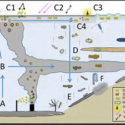
Scientists conducting oil spill research participated in the 2013 Marine Oil Snow Sedimentation and Flocculent Accumulation (MOSSFA) workshop. The researchers discussed the formation and fate of oil-associated marine snow and its ecological impacts on deep-sea environments and made recommendations for future marine oil snow research.
|
|
|
Scientists ran model simulations for oil evaporation based on composition measurements of fresh Macondo crude oil and weathered surface oil from Deepwater Horizon slicks.
|
|
|
Scientists conducted laboratory exposure experiments to assess the effects of dispersed crude oil, Corexit 9500A dispersant, and natural ultraviolet B (UVB) radiation on early larval stages of planktonic copepods (“nauplii”).
|
|
|
The Gulf of Mexico Research Initiative (GoMRI) congratulates its Research Board Chair Dr. Rita Colwell for her selection as a National Academy of Inventors Fellow.
|
|
|
Posted on January 20, 2016
Scientists compared phytoplankton time-series data collected in Louisiana coastal waters after the Deepwater Horizon spill. They found that phytoplankton abundance was significantly lower in 2010 and that the community’s species composition significantly shifted immediately after the spill.
|
|
|
Posted on January 20, 2015
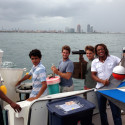
What do CARTHE, the International SeaKeepers Society, and Fleet Miami have in common? Ocean research!
|
|
|
Posted on January 17, 2014
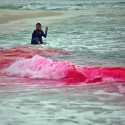
Rolling waves, swirling currents, converging fronts, shifting sediments – all are connected as anyone who has chased a ball in beach waters knows. But how?
|
|
|
Study Develops Predictive Model for Oil-Particle Aggregate Formation
A-DROP: A predictive model for the formation of oil particle aggregates (OPAs). Zhao, L.; Boufadel, M.C.; Geng, X.; Lee, K.; King, T.; Robinson, B.; Fitzpatrick, F. Marine Pollution Bulletin. Volume 106, Issues 1–2, 15 May 2016, Pages 245–259
Study Demonstrates that Sinking Marine Particles Help Remove PAHs from Water Column
Vertical fluxes of polycyclic aromatic hydrocarbons in the northern Gulf of Mexico. Adhikari, P.L.; Maiti, K.; Overton, E.B. Marine Chemistry, Volume 168, 20 January 2015, Pages 60–68.
|
|
R/V Point Sur: PS17-08 Acoustic Doppler Current Profiler (ADCP) data, Gulf of Mexico, October 5 - 9, 2016 -- data link
Four ensembles of TAMOC integral oil-gas plume simulations for comparison of uncertainty quantification techniques -- data link
Common Loon Behavioral, PAH and Health Data, 2015, Louisiana -- data link
|
|
|
GoMRI RFP-V: Chemical evolution & degradation of petroleum in saline marsh plants & soils (Van Bael)
Project is lead by P.I. Sunshine Van Bael, Tulane University.
|
|
|
|
|
|
|
|