Hydrocarbons associated with oil spills can have harmful effects on humans and organisms, yet little is known about the specific compounds that contribute to toxicity.
Posted on November 19, 2015
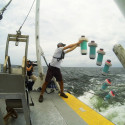
Chemical engineer Jordan Young has found his happy place on a research vessel in the Gulf of Mexico. He’s looking for changes in ocean acidity following the Deepwater Horizon spill. As the oil biologically degrades, some of it oxidizes to carbon dioxide and may increase acidification.
Posted on November 21, 2014
Chemists from Oregon State University developed a method that detects and measures the chemical composition of the four Corexit surfactants in seawater.
Posted on November 18, 2013
In the early morning hours on Monday July 23rd the Hercules 252 rig blew out, spewing a mixture of gas, condensate, and possibly other hydrocarbons into the water and air.
Posted on November 8, 2012
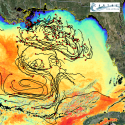
As the Globalstar transmission shut down approaches, ending the GPS data collection phase of CARTHE’s Grand Lagrangian Deployment (GLAD), the team is still collecting data from the largest upper-ocean dispersion experiment of its kind.
Study Shows UAVs Provide Moderate Spatial and High Temporal Resolution Imagery Surf zone monitoring using rotary wing Unmanned Aerial Vehicles Brouwer, R.L.; de Schipper, M.A.; Rynne, P.F.; Graham, F.J.; Reniers, A.J.H.M.; MacMahan, J.H. American Meteorological Society, 2014, Vol 32, 855-863
Data
Demersal fish species assemblages and relative abundance from R/V Apalachee (AP-3512), DeSoto Canyon, November 2015 - data link
Shipboard ADCP, underway near surface meteorology and hydrography, G04 cruise, Deepwater Horizon oil spill region, July 2013. - data link
Exposure to ultraviolet radiation late in development increases the toxicity of oil to mahi mahi (Coryphaena hippurus) embryos - data link
Video
GoMRI RFP-V: Reproductive Failure in Deepwater Horizon Oil Spill and Recovery of Cetaceans (Smith)
Project is lead by P.I. Cynthia Smith, Marine Mammal Foundation.
Dispatches From the Gulf Honored with Blue Ocean Film Award
The Screenscope documentary highlighting GoMRI-funded research and scientists wins the Blue Whale Award for Best in Broadcast Program. The film also received Honorable Mention for Cinematography.
Project Activities
ACER Welcomes New Post-Doctoral Researcher
Dr. Corianne Tatariw recently joined the consortium’s Nitrogen Cycling group to investigate the impacts of the Deepwater Horizon oil spill on nitrogen cycling in the Chandeleur Islands.
Meet C-IMAGE Student of the Month Juan Viamonte
Juan is a Ph.D. student at the Hamburg University of Technology studying microorganisms at extreme conditions. He simulates Gulf seafloor conditions on bacteria to better understand how and to what extent crude oil is biodegraded under high pressure conditions.