|
|
|
|
April 5, 2016 GoMRI eNews
|
|
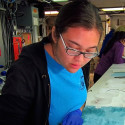
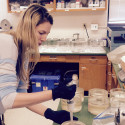
Laura Timm examines connections among shellfish ecology and evolution to help scientists understand how the Deepwater Horizon oil spill affected certain Gulf of Mexico species: “My work focuses on establishing pre-spill baselines and comparing them to samples taken 3-7 years after the oil spill, providing a timeline of crustacean recovery.”
|
|
|
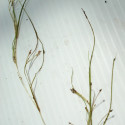
Scientists conducted experiments to assess oil exposure effects on Ruppa maritima, a common underwater plant species in Gulf of Mexico estuaries.
|
|
|
The Smithsonian Ocean Portal posted a blog that describes the needs and challenges of sharing scientific data, especially unique data collected after a disaster such as the Deepwater Horizon oil spill.
|
|
|
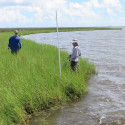
Scientists studied the relationship between the resiliency of Louisiana salt marsh plants, invertebrates, and microbes in heavily-oiled sediment after the Deepwater Horizon spill.
|
|
|
Posted on March 24, 2015
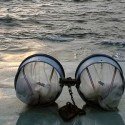
University of California Marine Science Institute researcher Uta Passow investigated the formation of aggregated oil and organic material, commonly called marine snow, after the Deepwater Horizon spill.
|
|
|
Posted on April 1, 2014
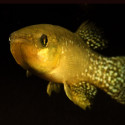
A team of researchers from Texas, Florida, and California successfully quantified the gene expression of wild Fundulus grandis, commonly known as Gulf killifish, from the northern Gulf of Mexico in assessing exposure to toxicants from the 2010 oil spill.
|
|
|
Posted on March 27, 2013
Scientists used a mathematical approach to uncover path-defining “structures” beneath Gulf waters that governed the movement of oil following the Deepwater Horizon oil spill.
|
|
|
Posted on April 4, 2012
March 2012. Dr. Kendra Daly and Leslie Schwierzke-Wade at the University of South Florida (USF) are leading a group of researchers from the USF College of Marine Science and the Florida Wildlife Research Institute to assess the impact of oil on the food web in Gulf waters off the Florida coast. Their team includes four graduate students.
|
|
|
Study Identifies Two Dominate Beaked Whales Species in Gulf of Mexico
Passive acoustic monitoring of beaked whale densities in the Gulf of Mexico. Hildebrand, J.A.; Baumann-Pickering, S.; Frasier, K.E.; Trickey, J.S.; Merkens, K.P.; Wiggins, S.M.; McDonald, M.A.; Garrison, L.P.; Harris, D.; Marques, T.A.; Thomas, L. Scientific Reports, 2015, 5, 16343
Study Documents Marine Microbial Response to Hercules Gas Blowout
Hercules 265 Rapid Response: Immediate ecosystem impacts of a natural gas blowout incident. Weber, S.C.; Battles, J.J.; Peterson, L.; Roberts, B.J.; Peterson, R.N.; Hollander, D.J.; Chanton, J.P.; Joye, S.B.; Montoya, J.P. Deep Sea Research Part II: Topical Studies in Oceanography, 2015, doi:10.1016/j.dsr2.2015.11.010
|
|
These seminars will be streaming live so you can participate remotely.
- April 6 in Austin, TX: Chilling with your chums: How did the oil spill impact Gulf fisheries? Register here. More info here.
- April 14 in Mobile, AL: Where did the oil go? Register here. More info here.
GoMRI eNews on Website
Sign up for the latest news and information about GoMRI research and activities delivered to your email address. Archived eNews are available, too. Go to the GoMRI website, hover over the 'News & Events' tab, and click on GoMRI eNews Bi-weekly Updates.
Conference Outreach Workshop Report Available: Sharing Oil Spill Science with Non-Scientists
Missed the February 1st workshop in Tampa, FL? Catch up by reading the report here. It includes the agenda, presenters' materials, and recaps of the breakout sessions.
|
|
RECOVER Highlights Research at Brewery
Researchers recently visited Saltwater Brewery in Delray Beach, Florida, to present and discuss their research with members of the community. You can find photos of the event here!
CONCORDE Teaches Research Techniques to Local Fishers
Consortium representatives recently partnered with the Mississippi Coalition of Vietnamese American Fisherfolk and Families to teach Mississippi Coast fishermen how they can measure temperature and salinity with depth. The fishermen will use their vessels to collect data as part of CONCORDE’S Spring Research Campaign.
CRGC Launches New Website
The project now has its own stand-alone presence on the web! Keep up with their research, outreach, and activities at resilientgulf.org.
CWC to Hold Field Marine Science Research Camp
The camp will allow students grades 9 – 12 to gain practical and real world experience conducting field research in south Louisiana coastal marshes while learning how to effectively communicate their research. Register by June 15!
DEEPEND Researcher Brings the Deep Sea to High School Classroom
Mike Novotny recently visited an environmental science class at Sheridan Technical High School to talk about the world’s largest biome, the deep sea. He explained the challenges, organisms, and adaptations of the deep sea’s unique ecosystems and passed around specimens of strange deep-sea creatures.
DROPPS and ADDOMEX Team Up at Documentary Screening
Members from both consortia recently visited the Witte Museum in San Antonio, Texas, to host a discussion panel following Screenscope documentary Dispatches from the Gulf.
ECOGIG Participates in Atlanta Science Festival
The annual event highlights regional STEAM (science, technology, engineering, arts, and mathematics) research and innovation. Visitors to the consortium tent could engage in activities such as piloting a model ROV and a “Build. Draw. Learn” station focused on coral.
Get to Know C-IMAGE Student of the Month Adriana Gaytán-Caballero
Adriana studies the natural hydrocarbon seepages on the Campeche knolls as a graduate student at Universidad Nacional Autónoma de México. Learn more about her research and growth as a scientist here.
ACER Spotlights Seagrass in “Habitat Focus”
The latest entry in the series discusses these flowering plants’ importance to coastal saline waters and why their populations have declined globally in recent years.
|
|
|
|
|
|
|