The Gulf of Mexico Research Initiative (GoMRI) Research Board announced today that it will award nearly $38 million to individuals and teams studying the effects of oil on the Gulf of Mexico ecosystem and public health. A total of 22 research proposals are being funded under this most recent GoMRI program.
Bryan Hamilton never planned to be a microbiologist, but when the opportunity arose to study microbes that produce biosurfactant in response to oil exposure, he was drawn in completely.
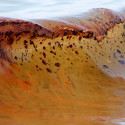
Scientists studied the interactions of the oil-degrading bacterium Alcanivorax borkumensis with oil across oil-water interfaces that had varying amounts of different surfactants.
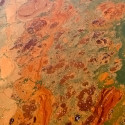
In the early morning hours on Monday July 23rd the Hercules 252 rig blew out, spewing a mixture of gas, condensate, and possibly other hydrocarbons into the water and air.
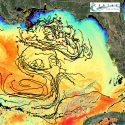
As the Globalstar transmission shut down approaches, ending the GPS data collection phase of CARTHE’s Grand Lagrangian Deployment (GLAD), the team is still collecting data from the largest upper-ocean dispersion experiment of its kind.
Publications
Study Compares Nutrient Enrichment and Oil Effects on Wetland Decomposition
Scientists will share their research addressing deep sea oil spill impacts on Dec 8 at the Harte Research Institute, Corpus Christi, TX. Click here to register. People can participate in-person or remotely.
Early Registration Closes Nov 20. Register now and save $100.
If you submitted an abstract, please confirm your presentation (oral or poster) by Nov 20. Check your email with instructions and a link to the confirmation site.
For more details about the conference venue and schedule, click here.
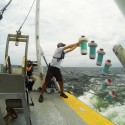
ADDOMEx Photoset Depicts Plankton Collection
The plankton will be inoculated in mesocosms at Texas A&M University at Galveston for the consortium’s second large-scale experiment.
RFP-II Researcher Named “Rising Star” in Chemistry Mindy Levine, a synthetic organic chemistry expert and researcher on the project Multifunctional Colloidal Particles as Dispersants for Maximizing Biodegradation of Crude Oil, recently won the Rising Star Award from the American Chemistry Society. Congratulations, Mindy!
CONCORDE Personnel Talk Research with Local Media Outlet
Scientists and students aboard R/V Point Sur had the opportunity to discuss their research and equipment with WLOX reporters during an early November crew change in Gulfport. You can read what they had to say here!
Deep-C Helps Develop New Ocean Modelling Software
The new software, OpenDrift, provides an open-source framework for modeling the trajectories and fate of particles drifting in the ocean and atmosphere. The software is expected to be released late 2015.
DEEPEND Discusses Light, Water, and Color in New Video The clip depicts how water can affect the color of light and how deep sea animals use this for camouflage. Students created underwater creatures out of colored paper and determine which colors offer the best camouflage.
DROPPS Researcher Presents at Del Mar College
Hernando Bacosa recently hosted a seminar at Del Mar College discussing the biodegradation and photooxidation of spilled oil in the northern Gulf of Mexico under various environmental conditions.
Captured Mahi Leading Active Lives in RECOVER Tanks
Researchers are examining how oil exposure can affect fish hearts. Check out the scientists measuring fishes’ performance in swim chambers as part of their research!