GoMRI eNews · Jul 28, 2015 · ← All issues
Help Share. Know three people interested in Gulf science? Please forward this email and share if you find it valuable.

Keeping you current on emerging Gulf science and the people investigating the effects of oil spills on the environment and public health.

July 28, 2015                                                                    GoMRI eNews

Stories

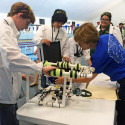
Scientists Put ROV Technology in Hands of Teachers and Students

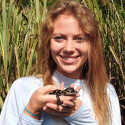
Smithsonian’s Five Questions with Marine Biomedical Grad Student Alexis Temkin

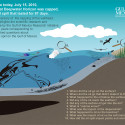
Capping Off the First Five Years of Scientific Research

Study Informs Oil Spill Forensics with Petroleum Biomarkers Degradation Data

From the Archives

Grad Student Harper Seeks to Improve Marine and Human Health with Science-Informed Policy

Alexandra Harper, a passionate environmental advocate, is using her oceanography expertise to help “society better balance human need with ecological health.”

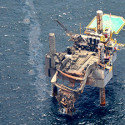
Scientific Dream Team Conducts Rapid Response Research at Hercules Gas Blowout

“This is an opportunity to put science into immediate practice.” – Tamay Ozgokmen, University of Miami and director of CARTHE

Publications

Study Shows Assimilation of Drifter Data Improves Trajectory Forecasts
Do assimilated drifter velocities improve Lagrangian predictability in an operational ocean model? Muscarella, P.; Carrier, M.J.; Ngodock, H.; Smith, S.; Lipphardt Jr., B.L.; Kirwan Jr., A.D.; Huntley, H.S. Monthly Weather Review, 2015, 143, 1822–1832
 
Study Shows Asymmetry between Effects on Upwelling and Downwelling
Nonlocal impacts of the Loop Current on cross-slope near-bottom flow in the northeastern Gulf of Mexico. Nguyen, T.-T.; Morey, S.L.; Dukhovskoy, D.S.; Chassignet, E.P. Geophysical Research Letters, 2015, 42, 2926–2933

Announcements

Oil Spill Seminar Aug 5 Pensacola, FL - Navigating Shifting Sands: Oil on our beaches
The Sea Grant Oil Spill Outreach Team invites you to attend. Scientists will share their work to answer questions about oil that washed up on Alabama and Florida beaches. 
View the Flyer.
 
The Sea Grant Oil Spill Outreach Team invites you to attend. Scientists will present published work regarding ecosystem effects, impacts to marsh life, and shoreline response and restoration. View the flyer.
 
Early registration ends Nov 20. 
The DEEPEND consortium announced a position for a Postdoctoral Research Associate in quantitative biological oceanography.

Project Activities

DROPPS Blog and Video Clip Highlight Laser Technology
Using holography technology, scientists were able to look more closely at the wayDeepwater Horizon oil plumes disperse with and without interference from microorganisms. To see what they found, read the blog and watch the video!

ADDOMEx Scientists Teach Boy Scouts about Phytoplankton
Kathy Schwer and Jennifer Genzer gave the Texas a troop a hands-on explanation of the oil spill, dispersants, and phytoplankton and showed them how to build their own phytoplankton models out of pipe cleaners.

Deep-C Researcher Featured on “Shark Week”
Shark expert Dean Grubbs and his team were recently featured on the program Alien Sharks: Close Encounters as part of Discovery Channel’s annual “Shark Week.” They discussed their investigation into the Deepwater Horizon oil spill’s effects on deep-sea creatures.
 
CARTHE Presents Research at Cuba Conference
Sharon Chinchilla presented CARTHE’s work at the 2015 Cubambiente International Convention on Environment and Development as part of an effort to reach Latin American communities in the Gulf of Mexico.

C-IMAGE Video Offers Advice to Young Scientists
Watch the clip to hear researchers in chemical oceanography, ecosystem modeling, and population genomics discuss the attitudes and motivations they believe are most important to becoming a successful scientist.
 
DEEPEND Researchers Send “Postcards from the Deep”
The digital “postcards” are part of the consortia’s K-5 outreach and contain photos and short letters from DEEPEND scientists explaining their interests, roles, and research activities.
 
Girl Scouts Dive into ECOGIG Day Camp
On June 23, the “Water, Water Everywhere” day camp taught approximately fifty Girl Scouts and Brownies about deep sea ecosystems and the way scientists use remotely operated vehicles (ROV) for deep-sea exploration.

LADC-GEMM Researcher Reflects on Passive Acoustic Monitoring (PAM)
In a recent blog post, Lead PAM Operator Lorenzo Scala explains how this monitoring technique works and why he thinks combining it with autonomous surface vehicles is an exciting and interesting new concept.